Showing posts with label injuries. Show all posts

Friday, 19 July 2013


Footwear must be worn routinely, or donned in certain locations for identified hazards on a temporary basis. Disposable shoes covers are available and recommended for some hazards, such as biohazards.


All employees in the affected areas must wear protective footwear when there is a risk of danger of foot injury due to falling or rolling objects, chemical hazards, and objects piercing the sole or electrical hazards. Employees who cannot wear safety shoes for medical reasons must furnish a letter to their supervisor form their physician stating the reason and the anticipated duration of the condition.


Additionally, safety footwear requires frequent checking to make sure every single area of the shoe is functioning properly. Check the bottom of the shoes to make sure the shoes has not expired.

General protective footwear, such as steel-toed or slip-resistant shoes may have to be paid for by the wearer due to its personal nature. Departmental policy may indicate that the department will pay for this type of footwear in full, partially or not at all. It is the employee’s responsibility to ensure that footwear purchased by the employee or the department is in good condition and is suitable for use in certain situations. Damaged or defective footwear will not provide the level of protection required, and should be replaced immediately.


In any case, please remember the employer has a duty in law to supply them free of charge to his employees. He cannot force them to wear unsuitable safety shoes and cannot subtract the cost of replacing them from their wages. This will not necessarily apply if they are short-term casual labour or contractors.

Monday, 15 July 2013

Safety Shoes Part III

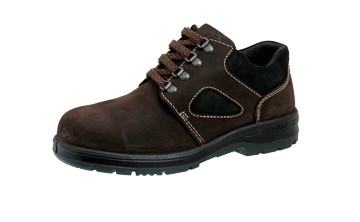
Enough with the leather series. King’s has an impressive display of PU-rubber series safety shoes as well. This is the brown leather series that are available.
These boots are extremely suitable for working in places that involves very temperature such as heat treatment, withstanding up to 300oC of heat. So all those who work in these environment, do check out this series of boots and keep your feet away from those hot stuff~

Do check them out at http://www.estore.com.sg/safety-shoes-c-165.html/page/2

Ladies, there’re shoes for you too!
Though these are not shoes that suitable for working in heavy-duty environment, they’re nonetheless resistant to oils, acids/alkalis. They’re also antistatic, impact resistant of up to 200 joules and are extra light.

Available in the Violet and Classic collection.


Female workers usually wear during work, such as the hotel industry, hospitals, bakeries, restaurants & cafés, light industries and so on.


Stay tuned to the next post on some new shoes that are available from WORKSafe and tips of checking out the expiration of the safety boots.

Sunday, 23 June 2013

Eye Injuries (Part II)

Traumatic iritis is inflammation of the colored part of the eye that surrounds the pupil (iris) and occurs after an eye injury. Traumatic iritis can be caused by a poke in the eye or a blow to the eye from a blunt object, such as a ball or a hand.

When the iris is injured, it becomes inflamed, and when the inside of the eye is inflamed, the body rushes white blood cells to the area to mend the problem and speed up healing.

The inflamed cells make it very sticky inside the eye; it may cause part of the iris or other parts of the eye to stick together, causing further damage. Also, the fluid in the front part of the eye, the aqueous humor, can fill with inflammatory cells and sometimes pigment or blood from the trauma, causing it to thicken. The thickened liquid may not be filtered out of the eye fast enough, causing eye pressure to rise to dangerous levels. On the contrary, sometimes the ciliary body is also traumatized, causing reduced eye pressure. Although this usually doesn’t lower eye pressure to dangerous levels, it is something that eye doctors pay close attention to.
Cr: www.uniteforsight.org

Traumatic iritis usually requires treatment. Even with medical treatment, there is a risk of permanent decreased vision.

Seek help from a doctor right away if you experience the following after 2-3 days you got hit.
·       eye ache or pain
·       sensitivity and pain when exposed to light
·       blurry vision
·       tearing
·       redness


What to do generally if you encounter eye injuries?
If you have any eye injury, contact your eye care practitioner immediately for advice.

In certain extreme situations such as a penetrating eye injury or an eye knocked out of the socket, it may be better to get to the hospital immediately without taking the time to try calling anyone.

Once you are in the care of a doctor, be sure to mention if you wear contact lenses so you can be advised whether to leave them in or remove them.

Depending on the type of eye injury, the doctor may want you to flush your eye with water or saline solution. In more serious situations, you may need surgery.

Treat all eye injuries as potential emergencies, and never hesitate to contact or see an eye doctor immediately.


Don't take risks with your eyesight. Remember, you have only one pair of eyes. Wear safety glasses to protect yourself.

You can check out the safety eyewear at http://www.estore.com.sg/safety-eyewear-c-173.html 

Tuesday, 18 June 2013

Eye Injuries (Part I)

Ho ho ho!

This is part I of the discussion about some common eye injuries that may occur during work or even at home. Do not ever underestimate these minor injuries as they can lead to very serious consequences or even blindness.

CORNEAL ABRASIONS  
The common causes of abrasions to the eye's surface (corneal abrasions) are getting poked in the eye or rubbing the eye when a foreign body is present, such as dust or sand. Corneal abrasions are very uncomfortable and cause eye redness and severe sensitivity to light.

Scratches make your eye susceptible to infection from bacteria or a fungus. Certain types of bacteria and fungi can enter the eye through a scratch and cause serious harm just within 24 hours. Blindness may even occur if whatever scratched your eye is dirty or contaminated.


Remedies
If you have a scratched eye, don't rub it. And don't patch your eye, either. Bacteria like dark, warm places to grow, and a patch might provide the ideal environment. Simply keep the eye closed or loosely tape a paper cup or eye shield over it. See your doctor as soon as possible to check out this type of eye injury.

Penetrating or Foreign Objects in the Eye

Your eye also may have corneal foreign bodies that are small, sharp pieces of a substance, usually metal, that have become embedded in the eye's surface (cornea), but have not penetrated into the interior of the eye.

Metal foreign bodies can quickly form a rust ring and a significant scar. Your eye doctor should remove these foreign bodies as soon as possible.

Remedies
Whenever a foreign object penetrates your eye, visit the emergency room/urgent care center immediately. Don’t attempt to remedy yourself because it may cause more injuries if you rub your eyes or remove the object yourself.

If possible, try loosely taping a paper cup or eye shield over your eye for protection; then seek help.


Stay tuned for the next installment of eye injuries and what to do when encountering eye injuries in general (: